
Introduction
I spend a lot of time thinking about gutters, which is an odd thing to admit. I design and make the LeafEnemy downspout filter at Worm Pop Labs, so when the leaves start coming down in autumn, people ask me the same question: do gutter guards work, or is a leaf guard a waste of money?
The honest answer is that gutter guards do one job well and several other jobs badly. They keep large debris out of your trough. Beyond that, the record gets mixed, and the way most guards are built creates problems that did not exist before you installed them.
This article walks through the real pros, the cons most installers gloss over, and the design flaw that ties them together. Then I'll show the approach we took instead: protecting the downspout, which is the actual choke point, for $14.95 rather than covering the whole gutter for thousands. You'll be able to judge which trade makes sense for your house.
So, do gutter guards work?
A gutter guard is a cover fitted over the top of an open gutter trough, meant to keep leaves and debris out while letting water in. Mesh screens, reverse-curve covers, bottle brushes and foam inserts all build on that same idea.
Gutter guards work at their narrow job: they block large leaves and twigs from entering the gutter. They don't end maintenance, they can slow water down in heavy rain, and they can hide the very clogs they promise to prevent. Whether they are worth it depends on which of those outcomes matters most at your house.
The real pros of gutter guards
Before the criticism, credit where it's due. These benefits are real, and they're the reason guards sell.
You clean your gutters less often
A guard keeps the big stuff out: full leaves, twigs, maple spinners. Instead of scooping a packed trough three or four times a year, many homeowners get down to once or twice. If you currently pay someone to clean your gutters, that is a genuine reduction in ladder trips and invoices.
They prevent catastrophic clogs
An unprotected gutter can dam up completely. Overflow pours over the edge, runs down the siding, and pools against the foundation, which is how wet basements happen. Guards stop the bulk debris that causes total blockages, and that protects the foundation and the landscaping below. This is the strongest argument for them.
They discourage pests from nesting
An open gutter full of wet leaves is an apartment listing for birds, wasps and mosquitoes. Cover it, and the nesting material never accumulates. Fewer tenants, fewer surprises in spring.
They can extend gutter life
Trapped organic debris holds moisture against the trough. Aluminum corrodes, steel rusts, wood fascia rots. Keeping most of that material out slows the decay. Gutters that drain and dry last longer than gutters holding a layer of wet compost.
They keep harvested rain cleaner
If you collect rainwater for a garden, water running through a trough of decomposing leaves arrives dark and full of tannins. A guard keeps most of that debris out, so the water reaching your barrel or cistern is cleaner. For rain harvesters, this is a real advantage.
The cons most installers don't mention
Here's where the sales pitch and the lived experience part ways. None of these are exotic edge cases. They're the predictable results of covering an open trough.

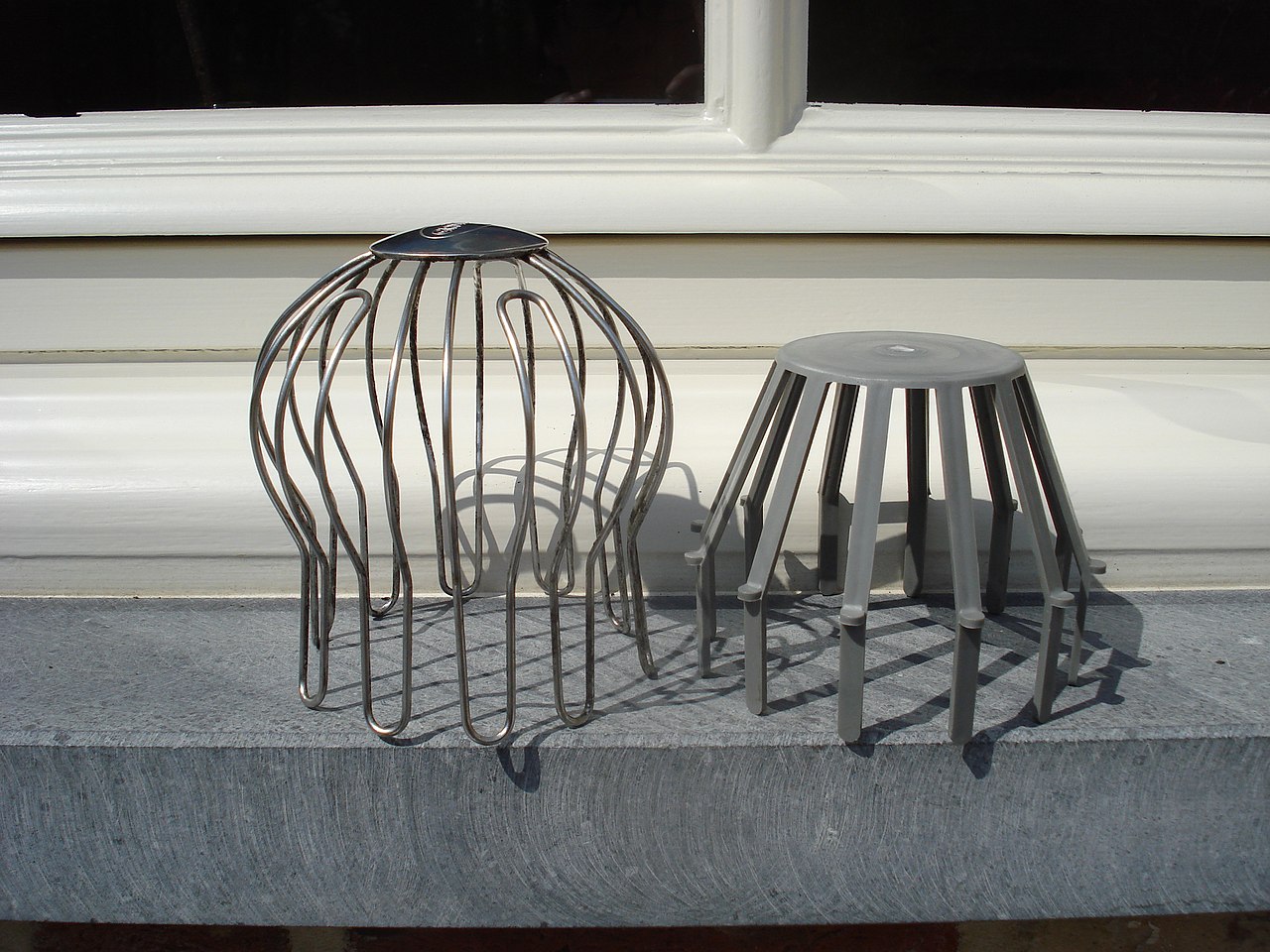
This is the guard most people picture: a solid cover spanning the full length of the trough. Photo: Stilfehler, CC BY-SA 4.0, via Wikimedia Commons.
Guards still need maintenance
Debris doesn't vanish because there's a screen on top. It sits there, mats down, and turns into a felt-like layer you have to brush or blast off, often twice a year, often from a ladder. You bought the guard to skip the ladder. The ladder is still in the plan.

What happens when nobody cleans the trough: debris, then a volunteer plant. Photo: Ted Garvin, CC BY-SA 2.5, via Wikimedia Commons.
Fine debris passes right through
Shingle grit, pollen, seed pods and pine needles are small enough to fit through mesh openings and the gaps in brush or foam. Once inside, they break down into a sludge that settles along the trough floor and heads for the downspout. The guard stopped the leaves. The sludge still clogs the drain.

Filter-style guards like this one have gaps fine debris passes through on its way to the downspout. Photo: Stilfehler, CC BY-SA 4.0, via Wikimedia Commons.
They conceal the clog until it's expensive
An open gutter shows you a clog. A covered gutter conceals it. Water disappears from view, and the first visible sign of trouble is often a stained fascia board, a damp foundation wall, or a basement that smells wrong. By then you're looking at the expensive symptoms, not the cheap cause.
Heavy rain can overshoot the trough
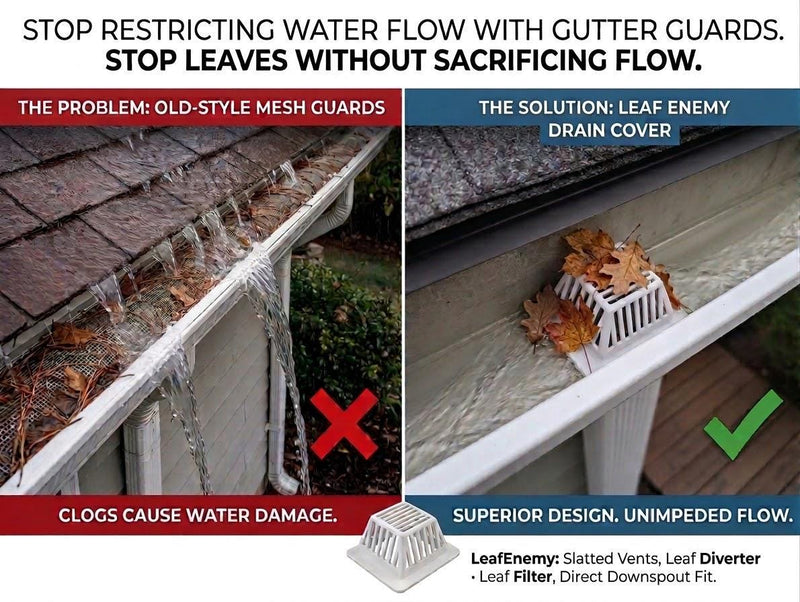
A mesh or reverse-curve cover admits water more slowly than an open trough. In a serious downpour, water sheets across the guard's surface and lands on the ground beside the foundation, the exact spot the gutter was installed to protect. In the heaviest rain, a guarded gutter can move less water than the open one it replaced.
Winter makes several problems worse
Snow sits on the cover, melts, refreezes, and builds ice at the roof edge. Frozen slush adds weight the hangers and fascia were never sized for. Ice damming itself is mostly an insulation and ventilation problem, but a cover that holds snow and standing water is not helping.

Ice damming at the roof edge, fed by attic heat loss. Photo: Dmcroof, CC BY-SA 3.0, via Wikimedia Commons.
The cost math is awkward
A professionally installed whole-house guard system runs to thousands of dollars, often comparable to replacing the gutters themselves. Compare that against paying someone to clean open gutters for a decade, and the payback window stretches well past the warranty on most products.
Installation can touch your roof warranty
Some guard systems anchor by tucking a lip beneath the shingles at the roof edge. Working under the shingle course is exactly the kind of thing some roofing warranties exclude. Before anything gets screwed in under your shingles, read the fine print you agreed to when the roof went on.
The design flaw behind most gutter guard problems
Read those cons again and a pattern shows up. Nearly every one, from the matting debris to the sludge, the hidden clogs, the overshoot, the ice, the weight and the warranty trouble, traces back to a single design decision: covering the entire trough.
The pattern is visible from the ground: the guard covers the trough, and everything downstream of it is out of sight. Photo: Ibu, CC BY-SA 4.0, via Wikimedia Commons.
That decision protects the wrong thing. A gutter trough is hard to kill. A trough full of dry leaves still passes water along its length; the water runs over the top of the debris until it reaches an outlet. The fragile part of the system is the downspout and whatever it feeds: a narrow pipe, often running underground, that a single fistful of leaves can seal shut. When that clog forms, it fails silently, under the lawn, where nobody sees it until the basement reports it.
So the logic flips. If the trough tolerates debris but the downspout doesn't, you don't need to cover forty feet of gutter. You need to protect each opening where the gutter hands water to a pipe. Everything upstream can stay open, visible and free-flowing.

Every gutter system ends at a downspout like this one. Photo: oatsy40, CC BY 2.0, via Wikimedia Commons.
A different approach: protect the downspout, not the whole gutter
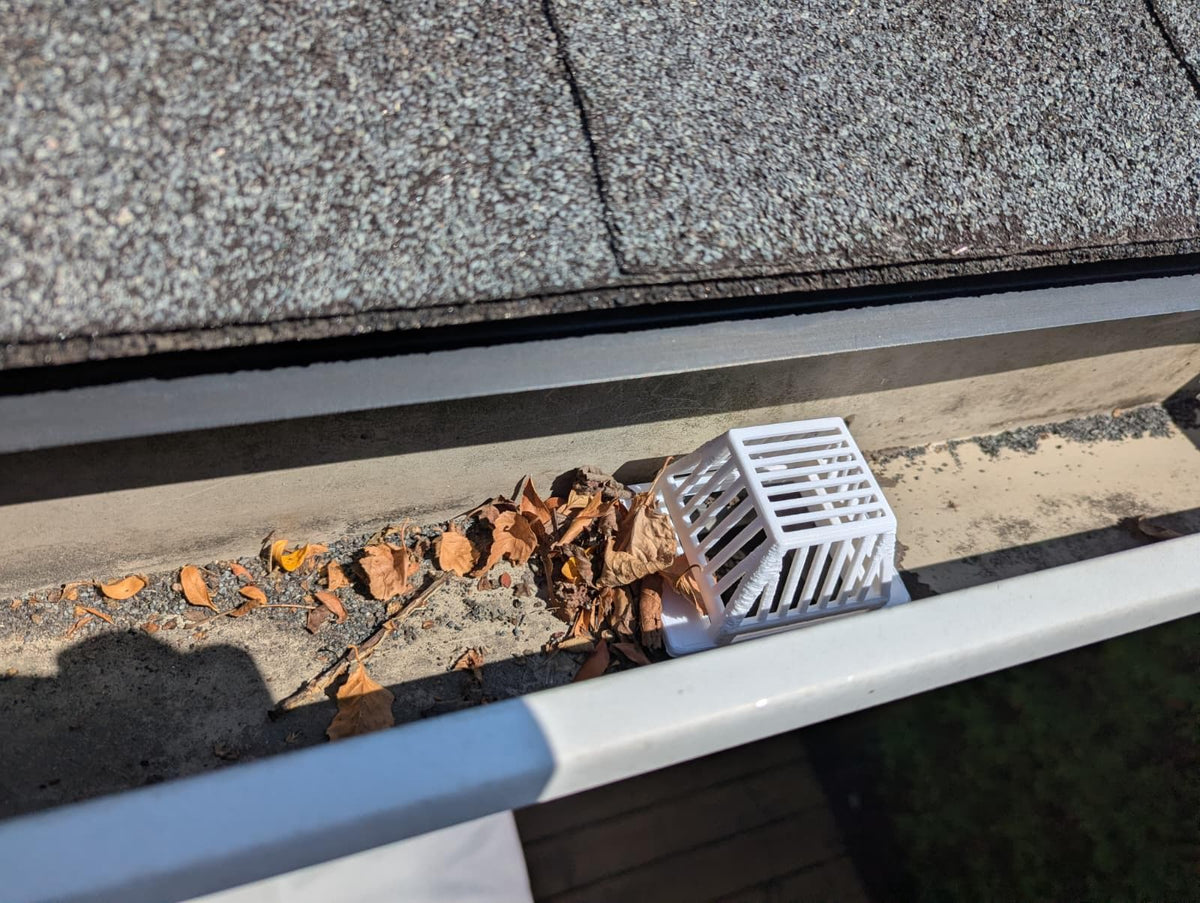
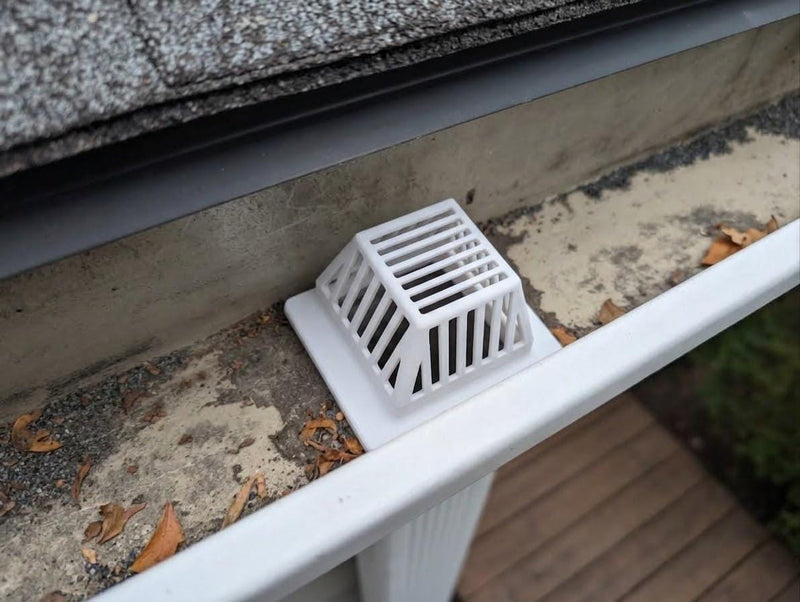
A downspout filter is a small cage that sits over the downspout's drop outlet inside the gutter. Water flows through it, and leaves pile against it instead of entering the pipe. That is the entire mechanism.
That's the approach we took with the LeafEnemy Gutter Downspout Filter. It's a $14.95 CAD cage that drops over the drop outlet. No screws, no caulk, no shingles lifted. The wide top and angled side slots keep up with heavy flow, and the debris it catches sits in the open trough where it stays dry, visible and easy to lift out.
The gutter above it stays an open gutter. Water enters at full speed, nothing is hidden, nothing is trapped against the fascia, and your roof warranty never enters the conversation. The filter guards the one component that actually clogs, the downspout and the underground drain it feeds, and leaves everything else alone.
How a downspout filter answers each gutter guard problem
| Gutter guard problem | Downspout filter approach |
|---|---|
| Debris mats on the cover and needs brushing off | Debris collects loose and dry in the open trough; scoop it out seasonally |
| Fine debris slips through and turns to sludge | Debris never enters the pipe, so sludge can't form inside the downspout |
| Clogs hide under a cover until they're expensive | Everything stays visible in the open trough |
| Heavy rain overshoots the cover | The open trough admits water at full speed |
| Ice and added weight strain the system | No cover holds snow; nothing is fastened to the roof |
| Whole-house systems cost thousands | $14.95 CAD per outlet |
| Under-shingle installation risks the roof warranty | Drops in tool-free; nothing touches the shingles |
Two more differences don't fit the table. The first is installation. The LeafEnemy seats over the outlet in about thirty seconds: lift it in, let it settle, done. The second is portability. Nothing is fastened, so if you replace your eavestroughs or move house, the filters lift out and come with you. A screwed-down guard system belongs to the house it was installed on. A cage you can carry in a bucket doesn't.
What a downspout filter doesn't do
Fairness runs both directions, so here's what this approach doesn't do. Leaves still land in your gutter. Every autumn the open trough collects them, and once or twice a season you'll want to scoop the loose, dry debris out along with the filter. A five-minute job, but a real one. An open gutter is exactly as visible and exactly as debris-friendly as it was before.
What changes is what that debris can do. It can't enter your downspout or your underground drain. It can't hide under a cover and rot into sludge. It sits in the open, stays dry, drains freely, and waits for a quick scoop instead of a plumbing snake.
If your goal is to never touch a ladder again, nothing on the market honestly sells you that, guards included, whatever the brochure says. If your goal is to protect the one part of the system that fails quietly and expensively, a fifteen-dollar cage does that job for a fraction of the price of a whole-house system.
Installing one takes about thirty seconds
- Find the drop outlet: the hole in the gutter floor where water enters the downspout, usually at a corner.
- Clear the debris sitting around it so the cage seats cleanly over the opening.
- Drop the filter over the outlet and let it settle. No screws, no caulk, no sealant. Removal is the same process in reverse.
Frequently asked questions
Do gutter guards really eliminate gutter cleaning?
No. Guards reduce how often you clean, but debris still mats on top of covers and fine particles still slip through. Most guarded gutters still need brushing once or twice a year.
What is a downspout filter?
A downspout filter is a small cage fitted over the downspout's drop outlet inside the gutter. It strains leaves and debris out of the water before it enters the downspout, protecting the pipe and any underground drain it feeds.
How much do gutter guards cost compared with a downspout filter?
Professionally installed whole-house guard systems typically cost thousands of dollars. The LeafEnemy downspout filter is $14.95 CAD per outlet, so a house with a handful of outlets is protected for under a hundred dollars.
Do gutter guards cause ice dams?
Ice dams form mainly from heat escaping the roof through poor insulation and ventilation, so guards don't cause them. But covers that hold snow and standing water add ice and weight at the roof edge, which can make an existing icing problem worse.
Are gutter guards worth it?
It depends on what you're buying. If deep leaf fall packs your troughs solid every year, guards reduce that and may justify their cost. If your actual risk is a clogged downspout flooding a basement or an underground drain, protecting the outlets directly does the same job for far less money.
The short version
Do gutter guards work? At their core job of keeping big debris out of the trough, yes, and the cleaner rainwater and longer gutter life are real benefits. But most of their problems come from one design decision: covering the whole trough. That is what mats debris, hides clogs, slows heavy rain, holds ice, costs thousands, and sometimes touches your roof warranty.
The trough isn't the fragile part. The downspout and the underground drain are. A $14.95 CAD cage over each outlet blocks leaves, pine needles and twigs from the pipe, keeps the gutter open and visible, installs in thirty seconds without tools, and lifts out when you need it or when you move.
Same protection where it counts. None of the cons where it doesn't.
I'm the maker behind Worm Pop Labs, where we design and make practical accessories like the LeafEnemy downspout filter in Canada and ship worldwide. Not sure what outlet you're working with? Send me your model or a photo and I'll point you to the right fit.


